

UNCLOS conciliation offers Cambodia, Thailand path to peace


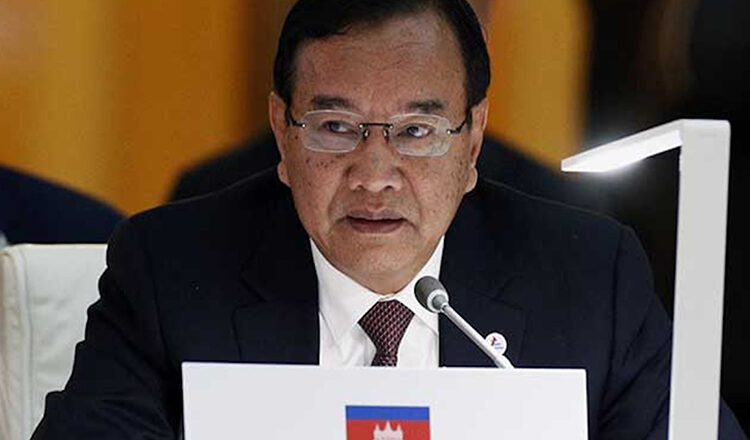
He stated that Cambodia has opted to pursue the UNCLOS conciliation process because it is a fair, internationally backed framework capable of resolving the decades-old dispute over overlapping claims in the Gulf of Thailand.
Cambodia formally launched compulsory conciliation proceedings under the United Nations Convention on the Law of the Sea (UNCLOS) on June 2.
In an op-ed published by Asia Times on Saturday, Sokhonn noted that Cambodia’s decision to initiate the proceedings followed Thailand’s withdrawal from a bilateral memorandum of understanding that had guided maritime boundary negotiations for more than two decades.
He welcomed Thailand’s subsequent decision to participate in the UNCLOS process, describing it as “a positive and welcome step”.
Drawing a parallel to regional diplomatic history, Sokhonn noted that a similar framework successfully resolved a seemingly intractable maritime deadlock between Timor-Leste and Australia.
In April 2016, Timor-Leste initiated the first-ever UNCLOS compulsory conciliation under Annex V of the convention to resolve its maritime boundary dispute with Australia. This process concluded on March 6, 2018, when both nations signed the historic Maritime Boundary Treaty at the UN headquarters in New York.
Sokhonn said the agreement demonstrated how international law could help states resolve disputes peacefully and fairly, regardless of their relative size or strength. He argued that the Cambodia-Thailand maritime dispute should be addressed through a combination of legal consistency, good-faith engagement and pragmatic consideration of the energy resources located within the disputed area.
He added that the dispute is not solely over maritime boundaries but also concerns the peaceful development and management of offshore resources that could contribute to economic growth and energy security for both countries. He said Cambodia was not seeking a one-sided outcome but rather a process to address the full scope of issues linked to the dispute.
Sokhonn underscored the importance of respecting international law in addressing tensions along the Cambodia-Thailand land border. While noting that the ceasefire remains in place, he warned that the situation remained fragile and reiterated Cambodia’s concerns regarding what he described as the occupation of the country’s territory.
“Borders and sovereignty must never be altered by force or fait accompli,” he wrote.
He called on both sides to continue dialogue and engagement through peaceful means, stressing that Cambodia remained committed to maintaining constructive relations with Thailand. He said the UNCLOS conciliation process represented an opportunity not only for Cambodia and Thailand but also for ASEAN and the wider international community to demonstrate support for peaceful dispute resolution through established international legal mechanisms.
“Cambodia welcomes Thailand’s engagement in the UNCLOS conciliation process. We ask that all sides engage in good faith. Our peoples, our region and the world will bear witness,” Sokhonn said.
Cambodia has appointed two internationally respected legal experts to serve on the compulsory conciliation commission established under UNCLOS to address overlapping maritime claims with Thailand.
The appointees are Peter Taksøe-Jensen, a Danish diplomat who chaired the UNCLOS conciliation commission that helped resolve the maritime dispute between Timor-Leste and Australia, and Jean-Marc Thouvenin, Secretary-General of the Hague Academy of International Law, who has frequently appeared before the International Court of Justice.
Thailand has agreed to take part in the compulsory conciliation process even though it expressed disappointment over the involvement of the United Nations, maintaining that any recommendations arising from the conciliation process are non-binding. It has suspended bilateral discussions on other matters while the UN-led proceedings are underway.
Speaking to reporters in Bangkok recently, Thai Foreign Minister Sihasak Phuangketkeow said Thailand would appoint two conciliators to participate in the UNCLOS process, while voicing disappointment over Cambodia’s decision to initiate the proceedings. Sihasak said Thailand believed the issue should first have been addressed through bilateral negotiations before being referred to the UNCLOS.
“Both sides should have spoken bilaterally first,” Sihasak said. “If we had talked and there was no progress, then we could go to UNCLOS.”
Speaking at the 3rd ASEAN Future Forum in Hanoi, Prime Minister Hun Manet said Cambodia’s move reflected its determination to pursue a peaceful and lasting solution to overlapping maritime claims.
“Cambodia’s recent decision to initiate compulsory conciliation under UNCLOS demonstrates our sincere desire to seek a fair and lasting solution firmly grounded in international law,” he said.