
National Assembly approves UNCLOS ratification law


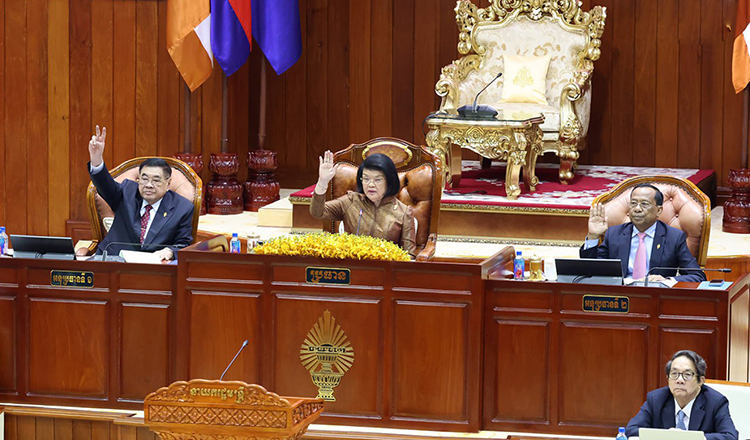
In a historic move, the National Assembly on Friday unanimously approved the draft law to ratify the United Nations Convention on the Law of the Sea (UNCLOS), marking a significant step in strengthening the Kingdom’s legal framework for maritime governance and international cooperation on ocean affairs.
The ratification was passed during the fifth plenary session of the National Assembly’s seventh legislature. National Assembly President Khuon Sudary chaired the session with 114 lawmakers in attendance, all of whom voted in favour of the draft law, according to an official statement from the Assembly’s Secretariat-General.
The draft law endorses Cambodia’s accession to UNCLOS, a comprehensive international treaty comprising 17 chapters, 320 articles and nine annexes. Cambodia signed the convention on July 1, 1983, and Friday’s vote formally paves the way for the Kingdom to deposit its instrument of ratification.
Prior to the passing of the law, the Permanent Committee of the National Assembly held a series of meetings to discuss and review the draft. The first meeting was convened on January 5.
The Secretariat-General said in statement that the ratification will provide Cambodia, as a coastal state, with a complete legal framework to govern maritime affairs in line with international law. It will also strengthen legal protections for Cambodia’s management of its maritime zones, including environmental conservation, exploitation of marine resources, and scientific research at sea.
In addition, the statement noted that joining UNCLOS will enhance Cambodia’s international standing by enabling greater cooperation on maritime governance and dispute resolution with other countries. By ratifying the agreement, Cambodia will also be able to cast ballots in elections for important international organisations created by UNCLOS, such as the International Tribunal for the Law of the Sea and the International Seabed Authority.
The ratification is also expected to facilitate technical and legal assistance from state parties and international institutions in areas related to marine environmental protection, conservation, and technology transfer.
The draft law contains three articles and was reviewed by the National Assembly’s Commission on Foreign Affairs, International Cooperation and Information. Commission chairman Suos Yara presented the review report to lawmakers during the session.
Foreign Affairs and International Cooperation Minister Prak Sokhonn, along with Lam Chea, Minister in Charge of the State Secretariat of Border Affairs, represented the government in defending the draft law before the Assembly.
UNCLOS, often described as the “constitution of the oceans,” establishes legal regimes for territorial seas, exclusive economic zones, continental shelves, navigation rights and marine environmental protection. The convention entered into force on November 16, 1994 after 60 ratifications were deposited with the UN Secretary-General, meeting the treaty’s required threshold.
The convention has been ratified by 168 parties, which includes 167 states (164 United Nations member states plus observer states Palestine, Cook Islands and Niue) and the European Union. An additional 14 UN member states have signed but not ratified the convention. Cambodia’s ratification brings the country closer into alignment with global maritime legal standards at a time of growing regional focus on maritime cooperation and resource management.
Pou Sothirak, Senior Advisor at the Cambodian Centre for Regional Studies, said Cambodia’s decision to ratify UNCLOS is to be commended. He credited the government of Japan for playing a catalytic role in encouraging and supporting Cambodia in the process.
“This much anticipated decision is a big welcome sign for Cambodia. Now, our kingdom will have the same legal rights provided under UNCLOS to safeguard our national interests in the maritime domain,” he said.
“Cambodia can now count on this universal Law of the Sea to protect its maritime sovereignty and interests against any illegal intrusions by neighboring countries which share sea boundaries with our country.”
Countries that ratify UNCLOS gain legal protection for their maritime rights, Sothirak said.
“Cambodia has a very long coastline. Under international law, a country is entitled to claim maritime resources up to 200 nautical miles from its land,” he explained.
“That means Cambodians have the right to ownership of these maritime resources, including fisheries and what lies beneath the seabed, which could include oil and gas. If we are a member, we can rely on international conventions, such as the Law of the Sea, to protect our national interests.”KhmerTime