
64 years on, ICJ ruling remains cornerstone of Cambodia’s rightful claim to Preah Vihear


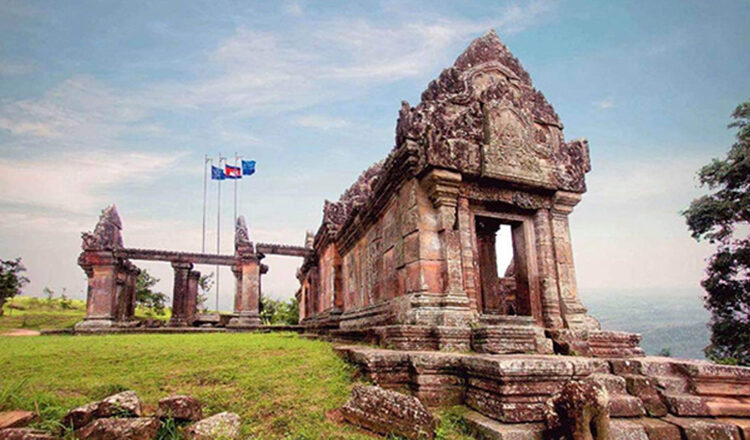
Yesterday marked the 64th anniversary of Cambodia’s victory at the International Court of Justice (ICJ) in the Preah Vihear Temple case, which historians and diplomats described as a landmark ruling that continues to shape regional history.
The verdict was delivered on June 15, 1962, nearly three years after the dispute formally reached the ICJ on October 6, 1959, when Cambodia filed an application asserting sovereignty over the temple and accusing Thailand of unlawful occupation. Rooted in the Franco-Siamese Treaty of 1904, the controversy centred on a map prepared by a joint commission that placed the temple on Cambodian soil.
Cambodia argued that this map had long governed the frontier and been tacitly accepted by both parties. Thailand countered that the map was not binding, claiming either non-acceptance or mistaken acceptance, and insisted the temple lies on the Thai side of the watershed line.
“Thailand asserted various arguments aimed at showing that the map had no binding character,” said Youk Chhang, a military historian and director of the Documentation Centre of Cambodia.
“One of its contentions was that the map had never been accepted by Thailand or, alternatively, that if Thailand had accepted it, it had done so only because of a mistaken belief that the frontier indicated corresponded to the watershed line.”

Thailand’s preliminary objections to the court’s jurisdiction in 1960 were dismissed in May 1961, paving the way for oral hearings at The Hague. Cambodia’s delegation included Truong Cang and Ouk Chhoum, supported by then US Secretary of State Dean Acheson; French professors Roger Pinto and Paul Reuter; and Colonel Ngin Karet as the survey expert.
Thailand’s team was led by Prince Vongsamahip Jayankura, assisted by Seni Pramoj—later Prime Minister of Thailand—alongside British lawyer Sir Frank Soskice and survey experts from the Royal Thai Survey Department.
On June 15, 1962, the ICJ ruled by nine votes to three that the Preah Vihear Temple lies within Cambodian territory. The court said Thailand had accepted the map through its conduct and silence and could not later repudiate it. Thailand was ordered to withdraw its forces and return artefacts that had been removed in 1954.
“The court found that Thailand had indeed accepted the map and concluded that the temple was situated on Cambodian territory,” Youk added. “It also held that Thailand was under an obligation to withdraw any military or police force stationed there and to restore to Cambodia any objects removed from the ruins since 1954.”
The aftermath was starkly different on the two sides of the border. In Cambodia, the judgement was celebrated as a diplomatic triumph and a symbol of national pride. King Father Norodom Sihanouk invoked the ruling to strengthen unity, presenting it as proof of Cambodia’s rightful heritage.
In Thailand, on the contrary, the decision was met with anger and humiliation, sparking protests and political turbulence. Though Thailand complied with the court jurisdiction, resentment lingered, and disputes over the surrounding land persisted.

Decades later, the issue resurfaced. UNESCO’s 2008 listing of Preah Vihear as a World Heritage Site reignited nationalist protests in Thailand and triggered armed clashes. Cambodia returned to the ICJ in 2011, seeking clarification of the 1962 ruling. In November 2013, the court reaffirmed Cambodia’s sovereignty not only over the temple but also over the promontory on which it stands, ordering Thailand to withdraw all forces. This interpretation reinforced the original judgement and underscored the enduring relevance of international law in regional disputes.
Sixty-four years on, the Preah Vihear Temple case remains a defining moment in Cambodia’s modern history, as it established sovereignty over one of the nation’s most sacred monuments, highlighted the binding power of treaties and maps, and demonstrated the role of international adjudication in shaping national identity, stressed Pou Sothirak, a retired diplomat and senior adviser at the Cambodian Centre for Regional Studies (CCRS).
“Whatever belonged to Cambodia legally, the International Court of Justice granted to it again and again. This recognition is historically significant. It affirms our sovereignty and gives us pride that international law upheld our rights,” he said.
Sothirak highlighted the legitimacy and finality of the ICJ’s authority in sovereignty disputes, pointing out that Cambodia had chosen to submit the Preah Vihear case to the ICJ because it is the highest judicial body for international law.
“When Thailand questioned ownership, Cambodia allowed the ICJ to decide. If Cambodia had lost, it would have accepted it. But Cambodia won, and Thailand had to acknowledge the ruling,” he said. “The ICJ is not an ordinary court—it is a global institution with authority over sovereignty disputes.”
According to Sothirak, then-Thai Prime Minister Surayud Chulanont in 2008 reserved the right to claim ownership if evidence emerged.
“But the maps Thailand used were drawn by its own military and had no legal value. Cambodia requested a reinterpretation, and in 2013 the ICJ clarified again: ‘The temple of Preah Vihear and the land surrounding it, the promontory, are situated inside Cambodian territory,’” he said.
Youk said the ICJ ruling on the Preah Vihear Temple shows that adherence to international law is a vital foundation for international peace and security.
“Legal proceedings offer a way to resolve disputes without resort to armed conflict,” he said. “The ICJ ruling on Preah Vihear thus provided a globally legitimate basis for peaceful and just relations between Thailand and Cambodia as they navigate challenges along their shared frontier.”
He warned that any attempt to ignore, challenge, or overturn a ruling by The Hague, especially through coercion, military action, or unilateral measures, is a strong threat to regional peace.
“Efforts to undermine the ICJ’s ruling or to reverse by force what the court has decided by law would cause deep ruptures not just to Thai-Cambodian relations but also to regional and global norms that are vital for Southeast Asia’s shared future,” Youk said.
The relative calm that followed the 2013 clarification shattered last year, when renewed border tensions culminated in two rounds of Thai military assaults. As a result, the Preah Vihear Temple suffered extensive damage.
The National Authority for Preah Vihear said experts identified 562 damaged sections across the temple complex, including collapsed walls, shattered roofing, and heavily scarred stone structures stretching from Gopura I to Gopura V.
Experts warn it could take up to 10 years just to stabilise the structures, while full restoration may take as long as 30 years and cost tens of millions of dollars. Cambodia has filed with UNESCO to assess the damage, and the international body is currently reviewing the matter.
Sothirak suggested that the matter of restoration and compensation should lie within the authority of UNESCO.
“Since 2008, when Preah Vihear was listed as a World Heritage Site for its universal value, UNESCO has recognised its significance,” he said.
“Whether Thailand bears responsibility or contributes to restoration is for UNESCO to determine. Cambodia has acted correctly under international law, and UNESCO’s involvement ensures the temple’s preservation and potential compensation,” Sothirak said.